玄妙莫测
发财龟派财百万神迹 波德申变发财胜地 2009/10/25 2:23:37 PM
(转载自《新生活报》)
派财灵龟在大马已不稀奇,但有一只灵龟,仿佛听得懂人的心事,洞悉人间的悲惨,假如有缘摸一摸它,它就会发动神力,安抚您脆弱无助的心灵。
或许真实故事太传奇,所以一传十,十传百,很多人都纷纷往波德申去,而且去的人除了想求财碰一碰运气,也想见一见这只‘看它知自己的心事有多深’,灵龟传奇的一面......
很多莫名的事情发生后,让您一生中都摸不着头脑,到底眼前这一只平凡无奇的乌龟,竟然可以摇身一变,变成大家心目中财力非凡的发财龟。
有人哀叹说,平时买万字,一个字都不会中,可是偏偏摸了这只乌龟后,身体就好像被充了电力一样,不过这不是电力,而是非凡的财力,竟然自己的车牌号码可以击中横财榜,准准看见自己的车牌号码出现在首奖的位子,高兴得三天三夜都睡不着觉,发梦都会在偷笑,中奖数额高达几万令吉!
这个人,不是冥冥中注定会大发横财,而是来到了波德申一间历史悠久,叫云龙庙的百年老庙摸龟去,当天摸了这只来历不明的老龟后,当天的车牌号码就正正开中在首奖,让他再也不质疑这只乌龟身上的确是沾满了财气。
起初,还有人因为质疑了这只乌龟竟然有派财的神力,可是,当这种含有猜测性的质疑越来就越强烈,偏偏,这只发财龟就是要你发财,似乎不太喜欢人家质疑它有派财的神力,所以,很多当初抱着好奇心来摸它的人,最终不得不信服这只发财龟,中奖神迹就活生生发生在自己的身上,自己也莫名或是迷迷糊糊的发了一笔大横财......
好吧!就说一说这位基督教徒的老兄,他从来都不会相信世间上会有如此神奇的事情发生,据说,有一天他带着一家大小到波德申一日游时,无意中听闻了附近有一间叫云龙庙的老庙,里头有只可以让人发财的老龟,于是带着一颗非常强烈的质疑心来到了这个地方。
当初老兄看见眼前如此可爱的老龟,走起路来像古代将军在行走如此的有气势,在庙的范围内爬来爬去,就深深被它吸引住了,最终还是伸出了双手在乌龟壳上面摸来摸去,甚至还摸了这只乌龟的头,可是,这只乌龟并没有变成‘缩头’乌龟,还伸出小龟头向他点了点头就走开了。
晚上,神奇的事情终于发生了,这位老兄对一对万字票根,不知道自己的眼睛是不是老花加深了,为什么车牌号码会在横财榜内有名,擦一擦眼睛,再看清楚,不得了啊!竟然正正开在首奖,让欣喜望外不已,思绪开始转动,马上让他联想到当天下午跑去摸灵龟,才会让他身上沾满了财气。
也许,这位老兄第一次的经历,已经是够神奇了,可是,这只发财龟仿佛以实际行动告诉了他:“我就是要你见识到我赐财的力量......”,就在他兴奋了一个星期后,喜讯接踵而来,当到云顶赌场‘大搏杀’ 的时候,竟然在拉积宝的环节,一拉,就让他拉到了总值6万9000令吉的款项,让他兴奋得上山,爽到下山。
除了活生生印证在这位老兄的身上之外,还有另一起很神奇的事迹,也发生了......
有一名建筑承包商,因为职场上生意非常不顺利,甚至被人拖欠了一大笔的债务,公司几乎面临关闭的现象,有一天,他就带着一颗失落的心情来到云龙庙,心想既然自己的一生这么失败,那就听天由命,倒不如来这里摸一摸发财龟,看看是否有扭转局势的一天。
当天,他就边摸这只灵龟边唉声叹息地说:“灵龟啊!灵龟,我现在真的很失意,如果你灵的话,就让我摸一摸你,希望我一摸就让我好运,二摸就让我发一发横财,三摸就让我事业一帆风顺......”,语毕,就黯然神伤的离开庙,然后乘车离开了。
说来,也真的不由得你不相信,这只灵龟仿佛听到了人间的悲惨的声音,就在当天晚上,让他的车牌号码9994正正开在二奖,让他发了3万多令吉的大横财,瞬间就解决了他公司一些资金周转不灵的问题了。
种种不同神迹的真实故事一度传开后,正所谓好消息传千里,竟然吸引了大批的善信前来摸灵龟,甚至每逢在礼拜天,有人租巴士组摸灵龟团,到来这里沾财气,希望自己可以转一转运,享受一下得到天掉下来的钱,到底可以有多爽快......
记者来到云龙庙,巧遇这一天是云龙庙荣府大人神诞的大好日子,人潮挤爆整间庙,早上九点多,人潮就已经高达百多人。
起初,还以为因为神诞才会那么多人,随后向这里的庙主求证后,原来不只是今天那么多人,一个礼拜七天都是那么的多人,如果是遇到公共假期,人潮最高纪录可达到千多人以上,大家都是冲着这只拥有派财法力的发财龟而来的。
当天,庙外插满了龙香和供奉了多只烧金猪,而且这些大部分都是属于还愿的供品,记者甚至还目睹了很多人下车时,手里一定捧着不同类型的供品来供奉云龙庙的众神祠,这里的理事还亲口告诉记者,这些善信其实是来还愿的,可想而知,中奖的人数,真的不计其数。
这一只自来灵龟的出现,竟然将森美兰波德申这个著名旅游胜地,平地一声雷转变成为发财胜地......
如今,这只灵龟莫名的出现,一夜间也莫名被成为大家心目中追捧的‘明星龟’。
“灵龟啊!灵龟!请你让我摸摸你,祈求你赐给我财力,让我发一笔大横财,到时候我会买好吃的鸡肉给你吃......”
位于波德申云龙庙最近出现了一只全身沾满财气的灵龟,据说,有人触摸了它的身体后,竟然中奖连连,仿佛这一只灵龟改变了他一生的财气。
说来也神奇,这一只被当地众善信称为发财龟,因为它在短短的一个月时间内,竟然已经派出超过百万令吉的横财,消息传开后,吸引了大批人前来目睹灵龟的庐山真面目,祈望带来好运。
这只具有神奇功能的“发财龟”,长约30公分,宽约13公分,重两公斤左右,其颜色与其它乌龟一样,只是模样长得颇为独特,所以也被人们称为“发财龟”。
其实,这一只自来灵龟,是于今年1月28日出现在云龙庙,当时,这里庙祝像平日一样早上前来开庙时,就发现来了一只乌龟,由于是属于自来龟,所以暂时收养了它,之后就开始喂食它吃菜,可是,这只乌龟偏偏就不吃,同样情况一直持续到一个月半。
当时庙祝还担心它会饿死,于是四处寻求众人的意见,到底要如何饲养它才好,最终获知可以喂食肉类,庙祝便给这只乌龟吃鸡肉,怎知它开始吃起来了,原来这只乌龟是吃荤的,不久后,它又神奇的离开了,庙祝当时在想,既然是自来龟,所以没有加于理会。
过了四个月后,这只乌龟一大清早又出现在庙门前,当时庙祝大感奇怪:“怎么又来了一只龟?”,详细看了一看,原来和之前闹失踪的那一只乌龟,长得一摸一样,这时才恍然大悟这一定是一只神奇的灵龟,竟然懂得认路回来,而且这一次回来,还对庙祝点了三下头,似乎在向庙祝鞠躬敬礼,之后就摇摇摆摆的走进去了。
当时,有一位妇女摸了这只灵龟后,晚上竟然发起一个怪梦来,梦中出现了四个号码,于是当天便下注,号码竟然击中多多横财榜,中了两万多令吉,让她难以置信这只乌龟的派财的神力,是如此的高强。
消息就是从这位妇女身上传开,演变成今天大伙人都赶路摸灵龟......
由于云龙庙的众理事觉得事有蹊跷,于是决定问神了解事情的来龙去脉和真相,神明当时对这班理事说,这只自来龟是一只已经有80多年的老灵龟,而且还是云龙庙荣府大人的化身,自从庙成立百多年以来,荣府大人都没有威过,所以这一次化身为一只带财的灵龟,主要是要大派横财给有缘的善信。
自此之后,很多善信都会将自己心水号码写在掌心后才来摸灵龟,据说这样就可以直接告诉灵龟,让自己的心水号码击中横财榜,而且说来还真的很玄异,短短的几个月内,就一一实现了很多人发横财的梦。
Showing posts with label Feng Shui. Show all posts
Showing posts with label Feng Shui. Show all posts
Saturday, October 24, 2009


Wednesday, April 1, 2009
前馬華總會長黃家定,家泉昆仲的祖墳
中華先賢爲何會選春分后穀雨前為清明節呢?(掃墓通常在清明前十天和后十天)原來古賢們發現春分是地球赤道和地球繞太陽運行的黃道重疊的節氣,故認爲在此時間内拜祭祖先,後人會和祖先骸骨的磁場產生感應,原理和電池充電雷同,所以這就是為什麼很多不孝子孫從不去掃墓運氣很差的原因。
讀者們如要有好的運氣,記得每年在清明時節要去掃墓,已盡孝道,求取好的磁場感應,改進運氣。
這期要介紹和分析的是座落在霹靂州玲瓏埠廣福義塚的前馬華總會長黃家定,家泉昆仲的祖墳。
此龙发脈自玲珑埠市区后的祖山,一路之玄,苍劲有力,高低起伏的往西奔去。另一支护龙在此龙脉的右手从护随行,左手有一大河,隨龍而流向朝山后聚成一湖。
此龍在奔走约莫3公里后,过峡起顶开帐出青龙砂,父母靠山为一圆顶贪狼星,落脉束气结穴,而黄家祖坟点在正穴位上,此龙结的乃是左单提穴,只有左方有青龙砂没有右白虎砂。但右方有一护龙一路环护捲案至前方形成案山和朝山
如果从墓穴正前方看去,案山为一武曲金星,案山后的朝山神似一个元宝形的官帽砂。此穴明堂开阔左青龙砂和右护砂挠案至明堂,形成一环护藏风聚气的堂局,气派万千,但此穴只发官贵,不发豪富,因为明堂内并无真水。
在理气上,此穴是三合派的造葬手法,合乙丙交而趨戌火局,坐卯向酉(坐東向西),堂局水口出戌墓库水,来龙辰,水口戌合玄空六法八运,雌雄挨星合十,另外也符合龙门八局水法和九星,辅卦等水法,但此墓的内堂造墓出水口在坤方为一错误的人造出水口,不吉,另外青龙砂合赖布衣先师所创的廿八宿催官拨砂法。
此墓的来龙,结穴,青龙砂,合催官拨砂法,向,案山,朝山(形似官帽砂)父母靠山为一圆顶贪狼星主出高官贵人,来龙入首辰当运,水法出戌八运当令,故无怪八運(1996年后)会孕育出黄家兄弟一门二傑,出二个一品高官(联邦正部长)。
但可惜的是其来龙只是约三公里远,龙气太短,故官运不太长,但黄家定曾做马华总会长,当朝华裔官职最高,兄长家泉官拜联邦房屋及地方政府部长,黄家可说光宗耀祖,此生无憾矣!





讀者們如要有好的運氣,記得每年在清明時節要去掃墓,已盡孝道,求取好的磁場感應,改進運氣。
這期要介紹和分析的是座落在霹靂州玲瓏埠廣福義塚的前馬華總會長黃家定,家泉昆仲的祖墳。
此龙发脈自玲珑埠市区后的祖山,一路之玄,苍劲有力,高低起伏的往西奔去。另一支护龙在此龙脉的右手从护随行,左手有一大河,隨龍而流向朝山后聚成一湖。
此龍在奔走约莫3公里后,过峡起顶开帐出青龙砂,父母靠山为一圆顶贪狼星,落脉束气结穴,而黄家祖坟点在正穴位上,此龙结的乃是左单提穴,只有左方有青龙砂没有右白虎砂。但右方有一护龙一路环护捲案至前方形成案山和朝山
如果从墓穴正前方看去,案山为一武曲金星,案山后的朝山神似一个元宝形的官帽砂。此穴明堂开阔左青龙砂和右护砂挠案至明堂,形成一环护藏风聚气的堂局,气派万千,但此穴只发官贵,不发豪富,因为明堂内并无真水。
在理气上,此穴是三合派的造葬手法,合乙丙交而趨戌火局,坐卯向酉(坐東向西),堂局水口出戌墓库水,来龙辰,水口戌合玄空六法八运,雌雄挨星合十,另外也符合龙门八局水法和九星,辅卦等水法,但此墓的内堂造墓出水口在坤方为一错误的人造出水口,不吉,另外青龙砂合赖布衣先师所创的廿八宿催官拨砂法。
此墓的来龙,结穴,青龙砂,合催官拨砂法,向,案山,朝山(形似官帽砂)父母靠山为一圆顶贪狼星主出高官贵人,来龙入首辰当运,水法出戌八运当令,故无怪八運(1996年后)会孕育出黄家兄弟一门二傑,出二个一品高官(联邦正部长)。
但可惜的是其来龙只是约三公里远,龙气太短,故官运不太长,但黄家定曾做马华总会长,当朝华裔官职最高,兄长家泉官拜联邦房屋及地方政府部长,黄家可说光宗耀祖,此生无憾矣!


Monday, March 2, 2009
Most interesting debate on Wen Wang Gua--a debate between the West and the East
Danny posted a very long message which was a bit difficult for a slow English reader like myself to comprehend. The worse thing was KC put my name on his reply by saying if I want to add anything. This makes me exposed and felt obliged to reply.
The reading of the hexagram took less time than reading the posting. Let me post a diagram and see if it benefits the discussion.
The casting is about tennis match, is about two people competing, as in combat. One interesting thing in making prediction of combat in WWG is that you have to figure out which line represents the home team and which line represents the guest team. For example, China team playing in China is obviously the home team, while playing outside of China is then the guest team. However, what if an Englishman wants to predict whether a German or a French is going to win, we will certainly have a hard time to figure out which is which. Trust me, if the quest is not specific enough, it would be quite difficult in doing the deciphering.
I don't know who originally made this casting and what had he in mind regarding the quest at the time. WWG can be very specific if only your quest is specific. I can only assume Hewitt is the home team as he is an Australian playing in his own country. That's make him the Subject Line 世爻, whereas his Opponent wil be the Object Line 應爻. Take note that both the Subject Line and the Object Line are not active, so it would have to see who gets more and better support and who is the strongest.

Mountain-Earth Bo 山地剝 is the 5th Alternate of the Chamber of Qian, Zi 子 the Child of Flying Serpent holds the Subject Line and Si 巳 the Officer of Azure Dragon hold the Object Line. Officer is defined as the one who devitalizes us, so it represents the enemy's troop. Wishfully we do not want to be defeated, so Child who devitalizes the Officer will be our troop.
In this castnig, it just happens that the Subject Line is holding the Child whereas the Object Line is holding the Officer. It indicates that it is an individual match rather than a team match. Zi is in the stage of Death while Si is in the stage of Rest when the seasonal strengths (according to the Month of Chou) has to be taken into consideration. They are both considered weak, however Rest is of better status when comparing to Death.
When reading a hexagram, we channel our attention primarily to those which are active, especially to examine if the Changed Line has any positive or negative effect onto its own Active Line. In this casting, both the Changed Lines, taking the advantage of being vitalized by the Day, are devitalizing their own Active Lines which virtually make the Active Lines become effectiveless, not to mention they are the Neutralized (people refers to void) during the Ten-Day Period of the day of casting.
During the day of Chou 丑, the Initial Line of Wei 未 the Parent becomes Aggressive Inactive, it's certainly posed a threat to the Subject Line. However, fortunately that the Invisible Line of Shen 申 the Sibling is active and turns the devitalization energy from Wei 未 into vitalizing the Subject Line. This would reflect on the spectators' expectation and wishful thinking. Once in a long while that an Australian could win in his own turf.
In the day of matching, it is the day of Jia-Yin 甲寅 and there the tide changed. Yin 寅 and Mao 卯 are no longer neutralized. The Uppermost Line of Yin 寅 the Asset becomes the Day Master, its Changed Line of You 酉 the Sibling can no longer pose any effect onto Yin 寅. Yin is free to pose its effect onto any other Lines especially being the Opposite of the only support of the Subject Line, the Invisible Shen 申. And worst, vitalizing the Object Line of Si 巳 the Officer. On the other hand, the Day Master of Yin 寅 also being the opposite of the Changed Line of Shen 申 in the 3rd Line, the result of which is to free Mao 卯 from being devitalized. Mao 卯 is then vitalizinig the Object Line. It is a clear indication that Safin (the Object Line) will win.
Note that the time of match has not been used.
A completed rule books of WWG was published during the Qing Dynasty, but it was a collective ideas and wisdoms since WWG was first matured during the Song Dynasty. It was written based upon the ancient social structure and protocols. As the world is evolving, we have offer it new meanings. The problem is not that it is an old book, the problem is the one who is using it.
Regards,
Jack
Reply by Anna 17 hours ago
Shifu, no wonder I couldn't explain it last night, I followed what was written in the first post, Safin as subject and Hewitt as object. I was wondering where Safin was from.
Thank you for explaining it so thorough as you always do.
Reply by KC Goh(吳繼宗) 15 hours ago
Jack and Danny,
It seems that different sifus have different opinion. Note that Danny interprets Safin as the subject line whereas Jack says Safin is the object line.
As Jack has put it, if an Englishman wants to predict whether a German or a French is going to win, he will certainly have a hard time to figure out whether German is the subject line or object line.
As Danny has said some people use subject to be the diviner and then object represents the market.
But some also said if you are doing divination for other person, the other person will become object line and the market will become subject line.
Jack, can you address the question of predicting the stock market? Whether it can be used in your opinion?
Jack, You are quite thorough in your interpretation because you also consider the other things like the child of flying serpent and azure dragon. many books actually did not talk about this. You also consider the seasonal strengths. There are so many things to consider making the interpretation of wen wang gua not an easy task.
Jack, I notice many people did not use the time when casting the gua. Do you know the reason?
Jack, I got another question for you. I normally use opening week composite index to add up and divide by 8 and the balance will form the upper gua. Then I would use the closing week composite index(CI) of the stock market to add up and divide by 8 and the balance will form the lower gua. For example, the opening week CI of the Malaysian stock market is 887.40 and Friday closing CI is 890.67. I used Friday(Feb 27, 2009) 5.01 pm as the casting time to form the gua as Fire-water wei ji is the 3rd alternate of the chamber of Li, changed 3rd line to become Fire-Wind, second alternate of the chamber of Li. This is to predict this week's market performance. What is your interpretation for this gua listed as follow? This week will mean Mar 2, Mar 3, Mar 4, Mar 5, Mar 6.
起卦方式:手工指定
公历时间:2009年2月27日17时1分 星期五
农历时间:己丑年二月初三酉时
干支:己丑年 丙寅月 癸卯日 辛酉时 (旬空:辰巳)
神煞:驿马—巳 桃花—子 日禄—子 贵人—卯,巳
离宫:火水未济 离宫:火风鼎
六神 伏 神 【本 卦】 【变 卦】
白虎 ▅▅▅▅▅ 兄弟己巳火 应 ▅▅▅▅▅ 兄弟己巳火
螣蛇 ▅▅ ▅▅ 子孙己未土 ▅▅ ▅▅ 子孙己未土 应
勾陈 ▅▅▅▅▅ 妻财己酉金 ▅▅▅▅▅ 妻财己酉金
朱雀官鬼己亥水▅▅ ▅▅ 兄弟戊午火 世×→ ▅▅▅▅▅ 妻财辛酉金
青龙 ▅▅▅▅▅ 子孙戊辰土 ▅▅▅▅▅ 官鬼辛亥水 世
玄武 ▅▅ ▅▅ 父母戊寅木 ▅▅ ▅▅ 子孙辛丑土
Danny, would you also care to express your opinion for the above gua?
Reply by Danny VdB 10 hours ago
Hi all,
The decision to use Safin as Subject was already made before the coins were thrown.
Most tennis matches do not have any home player, so that's not a criterion that can be used for all tennis games.
The same is with football world championships, all but one country are playing away from home, so in most matches there is no real home team.
That's why I always use the first name that is listed as the Subject, the second name is the Object.
Since the match was officially listed as Safin-Hewitt it means Safin was Subject.
If the match had been announced as Hewitt-Safin, then Hewitt would have been considered Subject in the reading.
This is an approach that can be consistently used through all games.
There is certain system used in tennis that decides who is listed first or second, I believe it has to do with where the player was in the draw, but we needn't discuss that here.
Anyway, this is how I do it for all tennis and football predictions.
***
After the facts when result is known, then it is always easy to find alternative interpretations and reasons why playerA has won, or why playerB has lost.
We all know that I Ching and WWG is very flexible.
If Hewitt had won the match we would probably find reasons in the reading why he won..
That's always the case.
The job is to read it before the match gets underway. My reading was done and published before the match.
Jack's analysis looks "pulled by the hairs" to me, and I am not sure what point he was trying to make here.
KC had asked if Hour can be used, and I told him we had done some experiments with it. He asked for an example, and I gave him.
Now, Jack seems to be trying to prove that Hour is not needed as his message concludes with "Note that the time of match has not been used."
But, nobody has said that Hour is "needed", of course we can still do readings without using the Hour.
All that was said is Hour "can" be used to get extra details as in this example.
We can read WWG in any way we want, but if we don't consider the Hour then there is no possibility to see that Hewitt will have much better start and Safin will only find the winning ways after the Pig Hour arrives.
One thing I found rather odd:
">In this casting, it just happens that the Subject Line is holding the Child whereas the Object Line is holding the Officer. It indicates that it is an individual match rather than a team match."
I think this makes no sense.
We could get this very same hexagram reading just as well for a football match or other team sport.
I have seen many team sport readings where the teams were given by Child and Officer lines.
About 4% of all readings will have Child and Officer as Subject and Object.
So how on earth does it indicate that it is an individual match rather than team match?
I don't see the logic.
Danny
Reply by Danny VdB 9 hours ago
Hi KC,
>Danny, would you also care to express your opinion for the above gua?
As far as I can see, this way of getting the hexagram by divide by 8 method is a flawed method for stock markets.
It is not difficult to see why.
For example we know that stock markets in the same region have a strong correlation.
If Germany goes down 2%, then you can be pretty sure France and Italy are also down that day.
It is no different in Asia, if Tokyo and Hong Kong are falling, then probably Malaysia stocks will also be down that day.
Some countries have more than one Index. In the US we have Dow Jones, Nasdaq, S&P,...
It is no secret that 90% of the time these indices go up or down together.
But of course each of these indices closes with very different numbers on Friday.
So, if we use your divide by 8 method based on Friday's closing price for each Index, then we will inevitably get different results for all exchanges and indices.
We will get very different results and predictions, depending on which index we used.
This proves the method is false, because we know from history that most world markets move in high correlation.
Danny
PS: It is no need to repeat the no offense topic all the time.
This is an international network and we assume that people who join and participate have the maturity not to feel attacked as soon as somebody disagrees with them.
Everyone has equal space to bring his arguments on the table and that's it.
Reply by Jack Chiu 7 hours ago
People may decipher WWG in their own way, but WWG by itself has its own interpretation rules. This is the reason why it can be repeatable, rather than being randomly picked and used. We can be flexible in the way of interpreting the event as circumstance may different, but it has to be explainable by the rules. Like gravitational force to apple. This is the scientific part of WWG. I guess this is the point I want to make.
Regardless of whether it is after-the-fact, the deciphering will be the same. I have done many deciphering, most of them on the fly, and am persistently using those rules. I have launched a complete interpretation of the rule book, one of my publications in applications of Yi-jing, and was largely received by WWG and Yi-jing lovers. I would have received criticism regarding my interpretation of the rules already, if there is any. I offer my reading to this case as academic study for those who found it meaningful and would accept those who may has different opinion, otherwise i will not be responding at the first place.
Regards,
Jack
Reply by KC Goh(吳繼宗) 5 hours ago
Jack,
I can see you probably are responding to Danny's comments. I hope you would still respond to the question I raised in the discussion.
I would invite other ww gua lovers to join in the discussion, people like Harmen Mesker and Nathalie Mourier.
Regards,
KC
Reply by Danny VdB 4 hours ago
Hi Jack,
>People may decipher WWG in their own way, but WWG by itself has its own interpretation rules.
I guess that's where we differ.
There are rules for calculation, and on that point WWG is pretty clear and rigid.
We both are not doing anything different when we calculate Gua Shen, or the timeliness of the lines, etcetera..
That's also why a computer can do that part of the job, because it is rigid mathematics.
But there are no "rules" for interpretation, at the most there is something like "guidelines" for interpretation.
Guidelines are more flexible than rules.
If there were rigid rules for interpretation, then it would not be interpretation, then it would also be part of calculation.
So, this is where schools and people differ : in their way of interpreting the various factors that are calculated in WWG.
For that the rules are not fixed and rigid.
If they were, then a computer would give us the complete interpretation as well, then an astrologer would not be needed.
The calculation part is easily repeatable, but the interpretation part is not.
That doesn't mean the interpretation is random.
Interpretation consists of judgement calls made by the astrologer, that's where he uses his experience.
Usually in a reading not all fingers are pointing in the same direction.
Some factors may favor the Subject line, some factors give advantage to Object, changing lines come in, etcetera.
Then the outcome is not written in stone.
The astrologer makes a judgement call as to which factors will gain the upper hand and shift the balance in one way or the other.
Sometimes it will be a very small detail that makes the difference.
Next the reality proves his judgement right or wrong.
It is in this part that after-the-fact is a lot more easy than before the fact.
The calculation part is the same, but the interpretation is a lot more easy when we know already what was the outcome.
If you don't believe me then you are welcome to post before-the-fact reading about tennis, stock market or whatever you want.
Next I will give my interpretations at the end of the market week or after the match is played.
***
Anyway, the real topic of this thread was about using the Hour in WWG.
So far all your comments have done everything except address KC's question, and I start wondering why.
Why don't you just tell KC that you are not in favor of using Hour, or that you think it is unnecessary, or that you have not experimented with it...
All would be perfectly OK answers..
I guess KC just hopes to use Hour for his stock market work.
We are not in China here. It is allowed to give straight answers to straight questions.
Danny
Reply by Jack Chiu 2 hours ago
Danny,
Why does it have to do with China, I don't get it. Perhaps I should learn a bit more western culture before I join this network. One thing I do learn from my limited international experience with over 30 years of business experience in high tech industry with US is that I don't put words in other's mouth and I respect people even business competitors.
Anyway, one thing I guess you are right is that you have different interprettion of the rules, and what you think it is for calculation. I may not exactly know what you are referring to. I may perhpas choose the wrong English word "rule" as it is from your standpoint referring to something rigid. Well, they are in fact quite rigid in order to maintain repeatability. The rules I am referring to is the interaction between lines and i don't think you will be able to calculate. Without these rules, it would be like a hitch hunch and that's why lots of talented and educated people are getting stuck.
The usage of Hour was not registered in WWG. As time evolves, people are tryinig to figure the meaning of Hour in WWG. I am not a big fan of Hour in WWG, but my research makes me an open-minded person as to whether the usage makes sense or not. I use my way of interpretation and highlight to KC that hour was not used. I didn't comment much on it. It is up to KC to search for the answer. In a subtle way, I am answering KC.
As I pointed out, regardless of whether it is after-the-fact, the decipherinig using the interpretation "rules" will be the same because it is repeatable.
I have offer my due service as a member to offer different opinion, now I will excuse myself from the topic.
Regards,
Jack
Reply by KC Goh(吳繼宗) 23 minutes ago
Danny and Jack,
I can feel the heat. Thank you for answering. I am sure many have benefited from the academic debate if they are interested in wwgua.
Regards,
KC
The reading of the hexagram took less time than reading the posting. Let me post a diagram and see if it benefits the discussion.
The casting is about tennis match, is about two people competing, as in combat. One interesting thing in making prediction of combat in WWG is that you have to figure out which line represents the home team and which line represents the guest team. For example, China team playing in China is obviously the home team, while playing outside of China is then the guest team. However, what if an Englishman wants to predict whether a German or a French is going to win, we will certainly have a hard time to figure out which is which. Trust me, if the quest is not specific enough, it would be quite difficult in doing the deciphering.
I don't know who originally made this casting and what had he in mind regarding the quest at the time. WWG can be very specific if only your quest is specific. I can only assume Hewitt is the home team as he is an Australian playing in his own country. That's make him the Subject Line 世爻, whereas his Opponent wil be the Object Line 應爻. Take note that both the Subject Line and the Object Line are not active, so it would have to see who gets more and better support and who is the strongest.

Mountain-Earth Bo 山地剝 is the 5th Alternate of the Chamber of Qian, Zi 子 the Child of Flying Serpent holds the Subject Line and Si 巳 the Officer of Azure Dragon hold the Object Line. Officer is defined as the one who devitalizes us, so it represents the enemy's troop. Wishfully we do not want to be defeated, so Child who devitalizes the Officer will be our troop.
In this castnig, it just happens that the Subject Line is holding the Child whereas the Object Line is holding the Officer. It indicates that it is an individual match rather than a team match. Zi is in the stage of Death while Si is in the stage of Rest when the seasonal strengths (according to the Month of Chou) has to be taken into consideration. They are both considered weak, however Rest is of better status when comparing to Death.
When reading a hexagram, we channel our attention primarily to those which are active, especially to examine if the Changed Line has any positive or negative effect onto its own Active Line. In this casting, both the Changed Lines, taking the advantage of being vitalized by the Day, are devitalizing their own Active Lines which virtually make the Active Lines become effectiveless, not to mention they are the Neutralized (people refers to void) during the Ten-Day Period of the day of casting.
During the day of Chou 丑, the Initial Line of Wei 未 the Parent becomes Aggressive Inactive, it's certainly posed a threat to the Subject Line. However, fortunately that the Invisible Line of Shen 申 the Sibling is active and turns the devitalization energy from Wei 未 into vitalizing the Subject Line. This would reflect on the spectators' expectation and wishful thinking. Once in a long while that an Australian could win in his own turf.
In the day of matching, it is the day of Jia-Yin 甲寅 and there the tide changed. Yin 寅 and Mao 卯 are no longer neutralized. The Uppermost Line of Yin 寅 the Asset becomes the Day Master, its Changed Line of You 酉 the Sibling can no longer pose any effect onto Yin 寅. Yin is free to pose its effect onto any other Lines especially being the Opposite of the only support of the Subject Line, the Invisible Shen 申. And worst, vitalizing the Object Line of Si 巳 the Officer. On the other hand, the Day Master of Yin 寅 also being the opposite of the Changed Line of Shen 申 in the 3rd Line, the result of which is to free Mao 卯 from being devitalized. Mao 卯 is then vitalizinig the Object Line. It is a clear indication that Safin (the Object Line) will win.
Note that the time of match has not been used.
A completed rule books of WWG was published during the Qing Dynasty, but it was a collective ideas and wisdoms since WWG was first matured during the Song Dynasty. It was written based upon the ancient social structure and protocols. As the world is evolving, we have offer it new meanings. The problem is not that it is an old book, the problem is the one who is using it.
Regards,
Jack
Reply by Anna 17 hours ago
Shifu, no wonder I couldn't explain it last night, I followed what was written in the first post, Safin as subject and Hewitt as object. I was wondering where Safin was from.
Thank you for explaining it so thorough as you always do.
Reply by KC Goh(吳繼宗) 15 hours ago
Jack and Danny,
It seems that different sifus have different opinion. Note that Danny interprets Safin as the subject line whereas Jack says Safin is the object line.
As Jack has put it, if an Englishman wants to predict whether a German or a French is going to win, he will certainly have a hard time to figure out whether German is the subject line or object line.
As Danny has said some people use subject to be the diviner and then object represents the market.
But some also said if you are doing divination for other person, the other person will become object line and the market will become subject line.
Jack, can you address the question of predicting the stock market? Whether it can be used in your opinion?
Jack, You are quite thorough in your interpretation because you also consider the other things like the child of flying serpent and azure dragon. many books actually did not talk about this. You also consider the seasonal strengths. There are so many things to consider making the interpretation of wen wang gua not an easy task.
Jack, I notice many people did not use the time when casting the gua. Do you know the reason?
Jack, I got another question for you. I normally use opening week composite index to add up and divide by 8 and the balance will form the upper gua. Then I would use the closing week composite index(CI) of the stock market to add up and divide by 8 and the balance will form the lower gua. For example, the opening week CI of the Malaysian stock market is 887.40 and Friday closing CI is 890.67. I used Friday(Feb 27, 2009) 5.01 pm as the casting time to form the gua as Fire-water wei ji is the 3rd alternate of the chamber of Li, changed 3rd line to become Fire-Wind, second alternate of the chamber of Li. This is to predict this week's market performance. What is your interpretation for this gua listed as follow? This week will mean Mar 2, Mar 3, Mar 4, Mar 5, Mar 6.
起卦方式:手工指定
公历时间:2009年2月27日17时1分 星期五
农历时间:己丑年二月初三酉时
干支:己丑年 丙寅月 癸卯日 辛酉时 (旬空:辰巳)
神煞:驿马—巳 桃花—子 日禄—子 贵人—卯,巳
离宫:火水未济 离宫:火风鼎
六神 伏 神 【本 卦】 【变 卦】
白虎 ▅▅▅▅▅ 兄弟己巳火 应 ▅▅▅▅▅ 兄弟己巳火
螣蛇 ▅▅ ▅▅ 子孙己未土 ▅▅ ▅▅ 子孙己未土 应
勾陈 ▅▅▅▅▅ 妻财己酉金 ▅▅▅▅▅ 妻财己酉金
朱雀官鬼己亥水▅▅ ▅▅ 兄弟戊午火 世×→ ▅▅▅▅▅ 妻财辛酉金
青龙 ▅▅▅▅▅ 子孙戊辰土 ▅▅▅▅▅ 官鬼辛亥水 世
玄武 ▅▅ ▅▅ 父母戊寅木 ▅▅ ▅▅ 子孙辛丑土
Danny, would you also care to express your opinion for the above gua?
Reply by Danny VdB 10 hours ago
Hi all,
The decision to use Safin as Subject was already made before the coins were thrown.
Most tennis matches do not have any home player, so that's not a criterion that can be used for all tennis games.
The same is with football world championships, all but one country are playing away from home, so in most matches there is no real home team.
That's why I always use the first name that is listed as the Subject, the second name is the Object.
Since the match was officially listed as Safin-Hewitt it means Safin was Subject.
If the match had been announced as Hewitt-Safin, then Hewitt would have been considered Subject in the reading.
This is an approach that can be consistently used through all games.
There is certain system used in tennis that decides who is listed first or second, I believe it has to do with where the player was in the draw, but we needn't discuss that here.
Anyway, this is how I do it for all tennis and football predictions.
***
After the facts when result is known, then it is always easy to find alternative interpretations and reasons why playerA has won, or why playerB has lost.
We all know that I Ching and WWG is very flexible.
If Hewitt had won the match we would probably find reasons in the reading why he won..
That's always the case.
The job is to read it before the match gets underway. My reading was done and published before the match.
Jack's analysis looks "pulled by the hairs" to me, and I am not sure what point he was trying to make here.
KC had asked if Hour can be used, and I told him we had done some experiments with it. He asked for an example, and I gave him.
Now, Jack seems to be trying to prove that Hour is not needed as his message concludes with "Note that the time of match has not been used."
But, nobody has said that Hour is "needed", of course we can still do readings without using the Hour.
All that was said is Hour "can" be used to get extra details as in this example.
We can read WWG in any way we want, but if we don't consider the Hour then there is no possibility to see that Hewitt will have much better start and Safin will only find the winning ways after the Pig Hour arrives.
One thing I found rather odd:
">In this casting, it just happens that the Subject Line is holding the Child whereas the Object Line is holding the Officer. It indicates that it is an individual match rather than a team match."
I think this makes no sense.
We could get this very same hexagram reading just as well for a football match or other team sport.
I have seen many team sport readings where the teams were given by Child and Officer lines.
About 4% of all readings will have Child and Officer as Subject and Object.
So how on earth does it indicate that it is an individual match rather than team match?
I don't see the logic.
Danny
Reply by Danny VdB 9 hours ago
Hi KC,
>Danny, would you also care to express your opinion for the above gua?
As far as I can see, this way of getting the hexagram by divide by 8 method is a flawed method for stock markets.
It is not difficult to see why.
For example we know that stock markets in the same region have a strong correlation.
If Germany goes down 2%, then you can be pretty sure France and Italy are also down that day.
It is no different in Asia, if Tokyo and Hong Kong are falling, then probably Malaysia stocks will also be down that day.
Some countries have more than one Index. In the US we have Dow Jones, Nasdaq, S&P,...
It is no secret that 90% of the time these indices go up or down together.
But of course each of these indices closes with very different numbers on Friday.
So, if we use your divide by 8 method based on Friday's closing price for each Index, then we will inevitably get different results for all exchanges and indices.
We will get very different results and predictions, depending on which index we used.
This proves the method is false, because we know from history that most world markets move in high correlation.
Danny
PS: It is no need to repeat the no offense topic all the time.
This is an international network and we assume that people who join and participate have the maturity not to feel attacked as soon as somebody disagrees with them.
Everyone has equal space to bring his arguments on the table and that's it.
Reply by Jack Chiu 7 hours ago
People may decipher WWG in their own way, but WWG by itself has its own interpretation rules. This is the reason why it can be repeatable, rather than being randomly picked and used. We can be flexible in the way of interpreting the event as circumstance may different, but it has to be explainable by the rules. Like gravitational force to apple. This is the scientific part of WWG. I guess this is the point I want to make.
Regardless of whether it is after-the-fact, the deciphering will be the same. I have done many deciphering, most of them on the fly, and am persistently using those rules. I have launched a complete interpretation of the rule book, one of my publications in applications of Yi-jing, and was largely received by WWG and Yi-jing lovers. I would have received criticism regarding my interpretation of the rules already, if there is any. I offer my reading to this case as academic study for those who found it meaningful and would accept those who may has different opinion, otherwise i will not be responding at the first place.
Regards,
Jack
Reply by KC Goh(吳繼宗) 5 hours ago
Jack,
I can see you probably are responding to Danny's comments. I hope you would still respond to the question I raised in the discussion.
I would invite other ww gua lovers to join in the discussion, people like Harmen Mesker and Nathalie Mourier.
Regards,
KC
Reply by Danny VdB 4 hours ago
Hi Jack,
>People may decipher WWG in their own way, but WWG by itself has its own interpretation rules.
I guess that's where we differ.
There are rules for calculation, and on that point WWG is pretty clear and rigid.
We both are not doing anything different when we calculate Gua Shen, or the timeliness of the lines, etcetera..
That's also why a computer can do that part of the job, because it is rigid mathematics.
But there are no "rules" for interpretation, at the most there is something like "guidelines" for interpretation.
Guidelines are more flexible than rules.
If there were rigid rules for interpretation, then it would not be interpretation, then it would also be part of calculation.
So, this is where schools and people differ : in their way of interpreting the various factors that are calculated in WWG.
For that the rules are not fixed and rigid.
If they were, then a computer would give us the complete interpretation as well, then an astrologer would not be needed.
The calculation part is easily repeatable, but the interpretation part is not.
That doesn't mean the interpretation is random.
Interpretation consists of judgement calls made by the astrologer, that's where he uses his experience.
Usually in a reading not all fingers are pointing in the same direction.
Some factors may favor the Subject line, some factors give advantage to Object, changing lines come in, etcetera.
Then the outcome is not written in stone.
The astrologer makes a judgement call as to which factors will gain the upper hand and shift the balance in one way or the other.
Sometimes it will be a very small detail that makes the difference.
Next the reality proves his judgement right or wrong.
It is in this part that after-the-fact is a lot more easy than before the fact.
The calculation part is the same, but the interpretation is a lot more easy when we know already what was the outcome.
If you don't believe me then you are welcome to post before-the-fact reading about tennis, stock market or whatever you want.
Next I will give my interpretations at the end of the market week or after the match is played.
***
Anyway, the real topic of this thread was about using the Hour in WWG.
So far all your comments have done everything except address KC's question, and I start wondering why.
Why don't you just tell KC that you are not in favor of using Hour, or that you think it is unnecessary, or that you have not experimented with it...
All would be perfectly OK answers..
I guess KC just hopes to use Hour for his stock market work.
We are not in China here. It is allowed to give straight answers to straight questions.
Danny
Reply by Jack Chiu 2 hours ago
Danny,
Why does it have to do with China, I don't get it. Perhaps I should learn a bit more western culture before I join this network. One thing I do learn from my limited international experience with over 30 years of business experience in high tech industry with US is that I don't put words in other's mouth and I respect people even business competitors.
Anyway, one thing I guess you are right is that you have different interprettion of the rules, and what you think it is for calculation. I may not exactly know what you are referring to. I may perhpas choose the wrong English word "rule" as it is from your standpoint referring to something rigid. Well, they are in fact quite rigid in order to maintain repeatability. The rules I am referring to is the interaction between lines and i don't think you will be able to calculate. Without these rules, it would be like a hitch hunch and that's why lots of talented and educated people are getting stuck.
The usage of Hour was not registered in WWG. As time evolves, people are tryinig to figure the meaning of Hour in WWG. I am not a big fan of Hour in WWG, but my research makes me an open-minded person as to whether the usage makes sense or not. I use my way of interpretation and highlight to KC that hour was not used. I didn't comment much on it. It is up to KC to search for the answer. In a subtle way, I am answering KC.
As I pointed out, regardless of whether it is after-the-fact, the decipherinig using the interpretation "rules" will be the same because it is repeatable.
I have offer my due service as a member to offer different opinion, now I will excuse myself from the topic.
Regards,
Jack
Reply by KC Goh(吳繼宗) 23 minutes ago
Danny and Jack,
I can feel the heat. Thank you for answering. I am sure many have benefited from the academic debate if they are interested in wwgua.
Regards,
KC
Sunday, March 1, 2009
Danny and Jack responding to KC comments on Wen Wang Gua
>The day of divination is ox which will combine with the rat to turn into earth which will also help the subject Safin. Do you agree?
Hi KC,
In this case it is true of course, but it was only one of many factors in the reading.
The main point is that the Hour when the match was played, and the change of Hour in mid match, gave us a very good picture of how the match evolved.
This means we can use the Hour to get more details.
Doing WWG is not about sticking 100% to the methods we find described in old books, we can go further.
Obviously there were no tennis matches or stock markets in those days, so we need to use logic how we will frame the reading when want to use it for sports events or stocks.
For example we have also done some experiments on the list about football world championships and so.
I am not a football fan, but when it is going to clutter our TV screens for weeks anyway, then why not use it for some tests?
Since these tournaments start with a group stage, with 4 or 6 teams in each group, I constructed a method to do just one reading for each group, with each team getting one line.
Then we tried to predict the matches and the final winner based on very few readings, covering all the groups and teams in one go.
Prognosis for the matches was done based on the lines for each team and on the day and hour the match was played.
This worked surprisingly well.
***
For stock markets I have seen some attempts to use WWG for it, but it was not very convincing.
Some people use Subject to be the diviner and then Object represents the market.
I think that easily leads to confusing picture.
The market is basically an ongoing struggle between buyers and sellers.
When the buyers are stronger then prices tend to go up, when the sellers are more strong then prices will tend to fall.
So a more logical framework is to consider Subject = Buyers, Object = Sellers.
Then the separating lines are just the middle men (like market makers or daytraders who typically buy and sell during the day). Sometimes the Sellers will be stronger than the buyers, but prices won't go down if the middle men absorb all that selling.
The outside lines in the reading are then outside market factors like political decisions or other news items.
To me that would be a more clear mapping for market prognosis purposes.
But I haven't tested it.
>I hope to see more of these kinds of examples
Well, bringing more examples will not make my idea or the approach any clearer.
I am very much a "be your own student" type of person.
Why would anyone want to fill his cup with my tea?
If you want you can try what I say and if it works for you then you can use it.
In doing so you will have created your own examples.
But if it doesn't work for you then just throw my ideas away.
That's what I do too if something doesn't work for me.
Danny
My name is called by KC in his reply which makes me vulnerable. In fact, I haven't read the entire message which Danny put up. It's rather lengthy and supposed in details. The only comment I would offer at this stage is that the reason while we do the casting is to seize the revelation that the divine power might have on a particular event and day. In most case, it's the day of the moment of thought. In Chinese, it is called 天機.
Under general practice, we will consider the date of the event, if it is known, and look it up in the hexagram which has already been casted. It is simply because WWG has the ability to predict. There is another school of thought saying that we should use the date of event if it is known and claiming to be more accurate, even the thought came prior to the actual event. I would leave it to other people to judge. To me, it is manipulating.
Regards,
Jack
Hi KC,
In this case it is true of course, but it was only one of many factors in the reading.
The main point is that the Hour when the match was played, and the change of Hour in mid match, gave us a very good picture of how the match evolved.
This means we can use the Hour to get more details.
Doing WWG is not about sticking 100% to the methods we find described in old books, we can go further.
Obviously there were no tennis matches or stock markets in those days, so we need to use logic how we will frame the reading when want to use it for sports events or stocks.
For example we have also done some experiments on the list about football world championships and so.
I am not a football fan, but when it is going to clutter our TV screens for weeks anyway, then why not use it for some tests?
Since these tournaments start with a group stage, with 4 or 6 teams in each group, I constructed a method to do just one reading for each group, with each team getting one line.
Then we tried to predict the matches and the final winner based on very few readings, covering all the groups and teams in one go.
Prognosis for the matches was done based on the lines for each team and on the day and hour the match was played.
This worked surprisingly well.
***
For stock markets I have seen some attempts to use WWG for it, but it was not very convincing.
Some people use Subject to be the diviner and then Object represents the market.
I think that easily leads to confusing picture.
The market is basically an ongoing struggle between buyers and sellers.
When the buyers are stronger then prices tend to go up, when the sellers are more strong then prices will tend to fall.
So a more logical framework is to consider Subject = Buyers, Object = Sellers.
Then the separating lines are just the middle men (like market makers or daytraders who typically buy and sell during the day). Sometimes the Sellers will be stronger than the buyers, but prices won't go down if the middle men absorb all that selling.
The outside lines in the reading are then outside market factors like political decisions or other news items.
To me that would be a more clear mapping for market prognosis purposes.
But I haven't tested it.
>I hope to see more of these kinds of examples
Well, bringing more examples will not make my idea or the approach any clearer.
I am very much a "be your own student" type of person.
Why would anyone want to fill his cup with my tea?
If you want you can try what I say and if it works for you then you can use it.
In doing so you will have created your own examples.
But if it doesn't work for you then just throw my ideas away.
That's what I do too if something doesn't work for me.
Danny
My name is called by KC in his reply which makes me vulnerable. In fact, I haven't read the entire message which Danny put up. It's rather lengthy and supposed in details. The only comment I would offer at this stage is that the reason while we do the casting is to seize the revelation that the divine power might have on a particular event and day. In most case, it's the day of the moment of thought. In Chinese, it is called 天機.
Under general practice, we will consider the date of the event, if it is known, and look it up in the hexagram which has already been casted. It is simply because WWG has the ability to predict. There is another school of thought saying that we should use the date of event if it is known and claiming to be more accurate, even the thought came prior to the actual event. I would leave it to other people to judge. To me, it is manipulating.
Regards,
Jack
Monday, February 23, 2009
Fengshui Cultural Heritage Bid Fans Science vs Superstition Debate
Fengshui Cultural Heritage Bid Fans Science vs Superstition Debate
Adjust font size: ZoomIn ZoomOut
A Shanghai organization has postponed plans to apply to make fengshui a "municipal intangible cultural heritage" after claiming biased news coverage reignited a controversy over its merits.

"I was pressured to stop the application before I finished it by a leader of Shanghai Social Sciences Association right after the local newspaper, Oriental Morning Post, released the story," said Zhang Liangren, vice chairman of the Shanghai Life Esthetics Association.
Zhang would not reveal the name of the leader, but he said the pressure began after the Oriental Morning Post published an allegedly slanted account of his application, which he planned to submit this month.
"The main reason why fengshui faces opposition is because many people and government officials think it is superstitious," Zhang said.
Widely practised in China for thousands of years, fengshui is commonly denigrated as a superstition rather than recognized as a cultural phenomenon by local government.
Fengshui means "wind and water" if directly translated from Chinese. It was also called Kanyu in ancient Chinese, meaning a geomantic omen applied to a building or a piece of land.
Traditionally, fengshui practitioners were usually consulted before construction or renovation of a building.
"Fengshui is a branch of science, rather than superstition," says the application of the Shanghai Life Esthetics Association, a member organization of Shanghai Social Sciences Association.
"As a building and location evaluation based on geology, landform and physiognomy, it is an important part of traditional Chinese culture," said Zhang.
He said applications in other east Asian countries triggered their action.
Emphasizing the harmonious co-existence of man and environment, fengshui is a discipline of geography, architecture, ethics and prophecy based on the Taoist principle that the earth, sky and man are part of one whole, said Zhang.
Although the Chinese government has never banned the practice officially, fengshui is defined in Chinese contemporary dictionaries as a "superstitious belief from ancient China".
Opponents, ranging from ordinary people to government officials, say recognition of this 'superstition' contradicts China's current concept of scientific development.
But a survey on Sohu.com, one of China's major websites, showed 80 percent of 1,200 people polled supported the application, while only 16 percent thought it was too superstitious and commercialized to be listed.
"I will never stop. We are aiming to restore the good reputation of fengshui," Zhang said.
A seminar on fengshui will be held in the near future, gathering as many scholars as possible to improve the application, Zhang said.
The biggest obstacle to the application lay in the lack of an appropriate representative of fengshui, said Zhang Liming, director of Shanghai Municipal Intangible Cultural Heritage Protection Center.
Although China has seen a revival of fengshui, the authorities could find no representative individuals or institutions, said Zhang Liming. Studies in universities were conducted only by individual professors, while the so-called "fengshui masters" were just out to make money.
"Zhang Liangren has put a lot of effort into the application for years. He discussed with me his application last year, but I have no authority to say 'yes' or 'no' to the application," Zhang Liming said.
Listing as a municipal intangible cultural heritage was the first step to world heritage listing, but it needed the approval from panels of academics and officials on three levels of municipal conferences, which considered applications, said Zhang Liming.
Head of the municipal academic panel Professor Chen Qinjian, from East China Normal University in Shanghai, said the main problem for the application was to distill the scientific elements in fengshui from the superstition.
Shanghai, with just 700 years of history, was much younger than fengshui culture, and not an ideal location for the application, Chen said.
Shanghai had a sound foundation as one of the origins of modern fengshui studies and further studies should be done to refine the scientific elements from the superstition, said Zhang Liangren who claimed to have an academic team of 25 scholars studying fengshui.
"Most professors studying fengshui in Shanghai are around 70 years old. We fear for the future of fengshui as a real and useful discipline, which is why I am doing this despite my age," said Zhang, 63.
Zhang said the study of fengshui would be better protected if it were recognized as an intangible cultural heritage.
Fengshui is an environment-evaluation system based on the philosophy of the ancient Book of Changes, said Peking University Professor Yu Xixian.
"Fengshui usually leads me to the same conclusions on building locations as architecture experts," Yu said.
The most famous use of fengshui in recent years was the Hong Kong Bank of China building, designed by architect Ieoh Ming Pei, said Shan Zhiqiang, executive chief editor of Chinese National Geographic.
"Some fengshui experts see the building as a sharp knife shining coldly in the center of Hong Kong, while Pei designed it to look like a spring bamboo shoot suggesting the life of the bank," said Shan.
Connected with creating luck, fengshui was making a comeback in China "in the name of science", warned Tao Shilong, a noted science fiction writer in an online forum earlier last year.
The word fengshui was first found in a book called Book of Burial written by Guo Pu 1,600 years ago, detailing how the location and decoration of a tomb could create luck for the occupant's descendants, Tao said.
"Fengshui is no science. It only swells the wallets of swindlers and raises unnecessary costs in building construction," Tao said.
His view was echoed by historian Gu Xiaoming, from Shanghai's Fudan University. "Fengshui contains too many mysterious elements which separate it from science."
Some principles are just simple learnings dating back to when the first house dwellers became aware of that a south-facing door was the best way to utilize sunshine, said Xu Pingfang, secretary general of the Chinese Society of Archaeology.
The Forbidden City in Beijing and many other cultural monuments were designed with fengshui theory in the hope of continuing a thriving and prosperous country, Xu said.
(Xinhua News Agency January 6, 2007)
Adjust font size: ZoomIn ZoomOut
A Shanghai organization has postponed plans to apply to make fengshui a "municipal intangible cultural heritage" after claiming biased news coverage reignited a controversy over its merits.

"I was pressured to stop the application before I finished it by a leader of Shanghai Social Sciences Association right after the local newspaper, Oriental Morning Post, released the story," said Zhang Liangren, vice chairman of the Shanghai Life Esthetics Association.
Zhang would not reveal the name of the leader, but he said the pressure began after the Oriental Morning Post published an allegedly slanted account of his application, which he planned to submit this month.
"The main reason why fengshui faces opposition is because many people and government officials think it is superstitious," Zhang said.
Widely practised in China for thousands of years, fengshui is commonly denigrated as a superstition rather than recognized as a cultural phenomenon by local government.
Fengshui means "wind and water" if directly translated from Chinese. It was also called Kanyu in ancient Chinese, meaning a geomantic omen applied to a building or a piece of land.
Traditionally, fengshui practitioners were usually consulted before construction or renovation of a building.
"Fengshui is a branch of science, rather than superstition," says the application of the Shanghai Life Esthetics Association, a member organization of Shanghai Social Sciences Association.
"As a building and location evaluation based on geology, landform and physiognomy, it is an important part of traditional Chinese culture," said Zhang.
He said applications in other east Asian countries triggered their action.
Emphasizing the harmonious co-existence of man and environment, fengshui is a discipline of geography, architecture, ethics and prophecy based on the Taoist principle that the earth, sky and man are part of one whole, said Zhang.
Although the Chinese government has never banned the practice officially, fengshui is defined in Chinese contemporary dictionaries as a "superstitious belief from ancient China".
Opponents, ranging from ordinary people to government officials, say recognition of this 'superstition' contradicts China's current concept of scientific development.
But a survey on Sohu.com, one of China's major websites, showed 80 percent of 1,200 people polled supported the application, while only 16 percent thought it was too superstitious and commercialized to be listed.
"I will never stop. We are aiming to restore the good reputation of fengshui," Zhang said.
A seminar on fengshui will be held in the near future, gathering as many scholars as possible to improve the application, Zhang said.
The biggest obstacle to the application lay in the lack of an appropriate representative of fengshui, said Zhang Liming, director of Shanghai Municipal Intangible Cultural Heritage Protection Center.
Although China has seen a revival of fengshui, the authorities could find no representative individuals or institutions, said Zhang Liming. Studies in universities were conducted only by individual professors, while the so-called "fengshui masters" were just out to make money.
"Zhang Liangren has put a lot of effort into the application for years. He discussed with me his application last year, but I have no authority to say 'yes' or 'no' to the application," Zhang Liming said.
Listing as a municipal intangible cultural heritage was the first step to world heritage listing, but it needed the approval from panels of academics and officials on three levels of municipal conferences, which considered applications, said Zhang Liming.
Head of the municipal academic panel Professor Chen Qinjian, from East China Normal University in Shanghai, said the main problem for the application was to distill the scientific elements in fengshui from the superstition.
Shanghai, with just 700 years of history, was much younger than fengshui culture, and not an ideal location for the application, Chen said.
Shanghai had a sound foundation as one of the origins of modern fengshui studies and further studies should be done to refine the scientific elements from the superstition, said Zhang Liangren who claimed to have an academic team of 25 scholars studying fengshui.
"Most professors studying fengshui in Shanghai are around 70 years old. We fear for the future of fengshui as a real and useful discipline, which is why I am doing this despite my age," said Zhang, 63.
Zhang said the study of fengshui would be better protected if it were recognized as an intangible cultural heritage.
Fengshui is an environment-evaluation system based on the philosophy of the ancient Book of Changes, said Peking University Professor Yu Xixian.
"Fengshui usually leads me to the same conclusions on building locations as architecture experts," Yu said.
The most famous use of fengshui in recent years was the Hong Kong Bank of China building, designed by architect Ieoh Ming Pei, said Shan Zhiqiang, executive chief editor of Chinese National Geographic.
"Some fengshui experts see the building as a sharp knife shining coldly in the center of Hong Kong, while Pei designed it to look like a spring bamboo shoot suggesting the life of the bank," said Shan.
Connected with creating luck, fengshui was making a comeback in China "in the name of science", warned Tao Shilong, a noted science fiction writer in an online forum earlier last year.
The word fengshui was first found in a book called Book of Burial written by Guo Pu 1,600 years ago, detailing how the location and decoration of a tomb could create luck for the occupant's descendants, Tao said.
"Fengshui is no science. It only swells the wallets of swindlers and raises unnecessary costs in building construction," Tao said.
His view was echoed by historian Gu Xiaoming, from Shanghai's Fudan University. "Fengshui contains too many mysterious elements which separate it from science."
Some principles are just simple learnings dating back to when the first house dwellers became aware of that a south-facing door was the best way to utilize sunshine, said Xu Pingfang, secretary general of the Chinese Society of Archaeology.
The Forbidden City in Beijing and many other cultural monuments were designed with fengshui theory in the hope of continuing a thriving and prosperous country, Xu said.
(Xinhua News Agency January 6, 2007)
University course signals rehabilitation of China´s fengshui
University course signals rehabilitation of China´s fengshui
Source: Xinhua | 10-13-2008 10:17
WUHAN, Oct. 12 (Xinhua) -- A course in fengshui, the traditional Chinese study of geomantic omens usually for buildings or cemeteries, in a central China university, became popular despite a long debate whether it is a science or simply superstition.
On Saturday, 130 students attended the first "Buildings and Fengshui" lecture given by Ma Wei, a teacher in School of Urban Construction, Wuhan University of Science and Technology Zhongnan Branch.
Ma had not expected so many students would choose the selective course as such courses in the university were normally restricted to 50 to 60. Thirty of the students were architecture majors.
"The course will comprise nine lectures, focusing on how to make residential buildings and their interior decor co-exist with their surrounding environments more harmoniously," said Ma.
Fengshui, literally translated as "wind and water", has been widely practiced in China for thousands of years, but in modern times it has been denigrated as a superstition rather than recognized as a cultural phenomenon, although it has seen a revival in recent years.
Traditionally, fengshui practitioners were usually consulted before the construction or renovation of a building.
Ma said a person's physical environment affected their psychological state, possibly altering their character and thereby their fortunes.
"College students born after 1980 show a strong interest in traditional Chinese culture," he said. "But they lack instruction. The fengshui course is intended to help students learn about traditional culture in a scientific way."
"When I first heard there would be such a class, I had some doubts and considered whether it was spreading superstition," said a senior 1architecture student surnamed Gao.
"But after the lecture, I find some logic in it," he said. "For example, the side of a building exposed to the sun should be considered when a house is built. This is actually a matter of harmony between homes and environment. This should not be regarded as superstition."
Ma's fengshui class is not the first in a Chinese university. In 2005, the China Architectural Culture Center of the Ministry of Housing and Urban-Rural Development and the elite Nanjing University based in eastern Jiangsu Province, launched a training program aimed at teaching the basics of traditional Chinese architecture and the ancient practice of fengshui.
Though the government has never banned the practice officially, fengshui is defined in Chinese dictionaries as "superstitious beliefs in ancient China".
The debate over fengshui has never stopped.
In early 2007, an organization in Shanghai had to postpone its plan to apply to make fengshui a "municipal intangible cultural heritage" after the plan was reported by media and sparked controversy.
"The main reason why fengshui faces opposition is because many people and government officials think it is superstitious," said Zhang Liangren, vice chairman of the Shanghai Life Esthetics Association.
"Fengshui is no science. It only swells the wallets of swindlers and raises unnecessary costs in building construction," said Tao Shilong, a noted science fiction writer. He warned that fengshui was making a comeback in China "in the name of science".
His view was echoed by historian Gu Xiaoming, from Shanghai's Fudan University. "Fengshui contains too many mysterious elements which separate it from science."
Ma Wei said fengshui was not superstition. Rather, it is a natural combination of scientific knowledge with living habits, with the aim of maintaining harmony between man and nature.
"Although many think fengshui unscientific, yet many others will more or less take it into consideration when building a house or decorate it," said Ma.
Editor:Zhang Ning
Source: Xinhua | 10-13-2008 10:17
WUHAN, Oct. 12 (Xinhua) -- A course in fengshui, the traditional Chinese study of geomantic omens usually for buildings or cemeteries, in a central China university, became popular despite a long debate whether it is a science or simply superstition.
On Saturday, 130 students attended the first "Buildings and Fengshui" lecture given by Ma Wei, a teacher in School of Urban Construction, Wuhan University of Science and Technology Zhongnan Branch.
Ma had not expected so many students would choose the selective course as such courses in the university were normally restricted to 50 to 60. Thirty of the students were architecture majors.
"The course will comprise nine lectures, focusing on how to make residential buildings and their interior decor co-exist with their surrounding environments more harmoniously," said Ma.
Fengshui, literally translated as "wind and water", has been widely practiced in China for thousands of years, but in modern times it has been denigrated as a superstition rather than recognized as a cultural phenomenon, although it has seen a revival in recent years.
Traditionally, fengshui practitioners were usually consulted before the construction or renovation of a building.
Ma said a person's physical environment affected their psychological state, possibly altering their character and thereby their fortunes.
"College students born after 1980 show a strong interest in traditional Chinese culture," he said. "But they lack instruction. The fengshui course is intended to help students learn about traditional culture in a scientific way."
"When I first heard there would be such a class, I had some doubts and considered whether it was spreading superstition," said a senior 1architecture student surnamed Gao.
"But after the lecture, I find some logic in it," he said. "For example, the side of a building exposed to the sun should be considered when a house is built. This is actually a matter of harmony between homes and environment. This should not be regarded as superstition."
Ma's fengshui class is not the first in a Chinese university. In 2005, the China Architectural Culture Center of the Ministry of Housing and Urban-Rural Development and the elite Nanjing University based in eastern Jiangsu Province, launched a training program aimed at teaching the basics of traditional Chinese architecture and the ancient practice of fengshui.
Though the government has never banned the practice officially, fengshui is defined in Chinese dictionaries as "superstitious beliefs in ancient China".
The debate over fengshui has never stopped.
In early 2007, an organization in Shanghai had to postpone its plan to apply to make fengshui a "municipal intangible cultural heritage" after the plan was reported by media and sparked controversy.
"The main reason why fengshui faces opposition is because many people and government officials think it is superstitious," said Zhang Liangren, vice chairman of the Shanghai Life Esthetics Association.
"Fengshui is no science. It only swells the wallets of swindlers and raises unnecessary costs in building construction," said Tao Shilong, a noted science fiction writer. He warned that fengshui was making a comeback in China "in the name of science".
His view was echoed by historian Gu Xiaoming, from Shanghai's Fudan University. "Fengshui contains too many mysterious elements which separate it from science."
Ma Wei said fengshui was not superstition. Rather, it is a natural combination of scientific knowledge with living habits, with the aim of maintaining harmony between man and nature.
"Although many think fengshui unscientific, yet many others will more or less take it into consideration when building a house or decorate it," said Ma.
Editor:Zhang Ning
Monday, February 16, 2009
Feng Shui color and material trend for 2009
Feng Shui colorjavascript:void(0) and material trend for 2009
Posted by howardchoy under art/architecture
No Comments
One of my students works for an interior design magazine and she wants to know just before Christmas last year how to use Feng Shui to predict the color and material trend for the coming year.
I told her Feng Shui prediction is done through correlative thinking, and one of the most widely used method is to associate the color and material with the elements of the coming year’s Stem and Branch and use the Wuxing Sheng-ke relationships to do the predictions.
It is more desirable to match the year’s elements; then use a good dose of generate-in, less dose of control-in, and avoid generate-out and control-out, unless one deems necessary. But she must also do the three following things as well:
One is to find out the trend for the current and past couple of years so she has a good sense of continuity from the past to present then she has a better chance of projecting her thoughts into the future.
Two is have a thorough understanding of the current social, political and economical situation of the world, in particular the country and the audience she writes for. The audience’s needs, fears and longings in a particular situation and time frame, should be addressed as fitful as possible in her predictions.
Three is to be general and not too specific in her predictions, and try not to pick a choice that will alienate too many people, but she has to be creative and slightly controversial at the same time to generate “ganying” (mutual response).
She asked me for an example, so I gave her the following practice piece, telling her this is a rough sketch because I have not done my proper research yet and my writing skill is geared for someone who knows a bit about how Feng Shui works and not for a more general audience. Her editor can help her better than I can in this aspect.
“With Yin Earth on Yin Earth, a receptive gray/yellow/brown organic earthy tone pallet will be the dominant Feng Shui color theme for the next year of the Ox. The accent is on a return to authentic and sustainable materials that makes one feels cool, protected and stable.
Next year’s color choice should make one feels nurtured and cared for. They are colors of hibernation deep deep down in the damp earth, but with a generous amount of fire red (generate in) accent to keep us warm and a little bit of wood green accent to keep us awake (control in).
If you ever dream of building a mud brick home, this is the year to do it, you don’t need to go and see your bank manager, just pick up a shovel and dig up the earth on your land to do it.
Make sure you mix the dirt with plenty of hay and water, don’t use corrugated iron for the roof, it will weaken the Earth, use an earth covered roof and grow grass on it for insulation instead.Don’t use metal windows either, use wooden ones instead and let them go gray naturally.
As for flooring material, it should be burnt clay or naturally exposed grayish concrete. Think Yin Earth with a little bit of warm Fire and naturally weathered Wood, being receptive and nurturing in your choice and you can’t go wrong in a Yin Earth on Yin Earth year of the Ox.”
Everything goes in cycles, I would like to think our 230 years old timber and mud farmhouse show below is trendy again in the year of the Ox. Come and spend a few days there, if you have the time:

Posted by howardchoy under art/architecture
No Comments
One of my students works for an interior design magazine and she wants to know just before Christmas last year how to use Feng Shui to predict the color and material trend for the coming year.
I told her Feng Shui prediction is done through correlative thinking, and one of the most widely used method is to associate the color and material with the elements of the coming year’s Stem and Branch and use the Wuxing Sheng-ke relationships to do the predictions.
It is more desirable to match the year’s elements; then use a good dose of generate-in, less dose of control-in, and avoid generate-out and control-out, unless one deems necessary. But she must also do the three following things as well:
One is to find out the trend for the current and past couple of years so she has a good sense of continuity from the past to present then she has a better chance of projecting her thoughts into the future.
Two is have a thorough understanding of the current social, political and economical situation of the world, in particular the country and the audience she writes for. The audience’s needs, fears and longings in a particular situation and time frame, should be addressed as fitful as possible in her predictions.
Three is to be general and not too specific in her predictions, and try not to pick a choice that will alienate too many people, but she has to be creative and slightly controversial at the same time to generate “ganying” (mutual response).
She asked me for an example, so I gave her the following practice piece, telling her this is a rough sketch because I have not done my proper research yet and my writing skill is geared for someone who knows a bit about how Feng Shui works and not for a more general audience. Her editor can help her better than I can in this aspect.
“With Yin Earth on Yin Earth, a receptive gray/yellow/brown organic earthy tone pallet will be the dominant Feng Shui color theme for the next year of the Ox. The accent is on a return to authentic and sustainable materials that makes one feels cool, protected and stable.
Next year’s color choice should make one feels nurtured and cared for. They are colors of hibernation deep deep down in the damp earth, but with a generous amount of fire red (generate in) accent to keep us warm and a little bit of wood green accent to keep us awake (control in).
If you ever dream of building a mud brick home, this is the year to do it, you don’t need to go and see your bank manager, just pick up a shovel and dig up the earth on your land to do it.
Make sure you mix the dirt with plenty of hay and water, don’t use corrugated iron for the roof, it will weaken the Earth, use an earth covered roof and grow grass on it for insulation instead.Don’t use metal windows either, use wooden ones instead and let them go gray naturally.
As for flooring material, it should be burnt clay or naturally exposed grayish concrete. Think Yin Earth with a little bit of warm Fire and naturally weathered Wood, being receptive and nurturing in your choice and you can’t go wrong in a Yin Earth on Yin Earth year of the Ox.”
Everything goes in cycles, I would like to think our 230 years old timber and mud farmhouse show below is trendy again in the year of the Ox. Come and spend a few days there, if you have the time:

Wednesday, January 7, 2009
2009流年开运风水大讲堂将於本月11日(星期日)下午2时至6时在巴生兰花园小学礼堂开讲.
(吉隆坡讯)
2009流年开运风水大讲堂将於本月11日(星期日)下午2时至6时在巴生兰花园小学礼堂开讲.
主讲人吴继宗硕士及杨淯珽师傅将会在这场为华校的慈善讲谈会上 “谈国运,论经济,股市及财富流向”。
杨淯珽师傅会特别论及2009流年风水如何摆设,以让你扭转乾坤。
这场由ING保险代理员公会雪州联委会主办的流年风水股市讲座,是要为吧生中华女子小学筹募建校基金;入场费每张RM60,现场有售票。
吴继宗硕士会谈国运卦及告诉你2009年的股市投资策略,到底 “现金为王”还是 “股市至上”各國中央银行將推出 “零”利息策略,你如何应对?吴氏是首邦股票行经纪及<<股市创富大赢家>>作者,他每周一在988电台指点投资兵法.
杨淯珽师傅精研各派阴阳宅风水,是SCS易经河洛理数研究中心主席,他也是我国数间挂牌公司的风水顾问。
预订门票请联络:012-3185557(MR.GAN), 012-3237727(MR.LEE), 03-33431008(MS LIM),03-33424288(MS LIM),016-2010591(MS LEE).
2009流年开运风水大讲堂将於本月11日(星期日)下午2时至6时在巴生兰花园小学礼堂开讲.
主讲人吴继宗硕士及杨淯珽师傅将会在这场为华校的慈善讲谈会上 “谈国运,论经济,股市及财富流向”。
杨淯珽师傅会特别论及2009流年风水如何摆设,以让你扭转乾坤。
这场由ING保险代理员公会雪州联委会主办的流年风水股市讲座,是要为吧生中华女子小学筹募建校基金;入场费每张RM60,现场有售票。
吴继宗硕士会谈国运卦及告诉你2009年的股市投资策略,到底 “现金为王”还是 “股市至上”各國中央银行將推出 “零”利息策略,你如何应对?吴氏是首邦股票行经纪及<<股市创富大赢家>>作者,他每周一在988电台指点投资兵法.
杨淯珽师傅精研各派阴阳宅风水,是SCS易经河洛理数研究中心主席,他也是我国数间挂牌公司的风水顾问。
预订门票请联络:012-3185557(MR.GAN), 012-3237727(MR.LEE), 03-33431008(MS LIM),03-33424288(MS LIM),016-2010591(MS LEE).
Wednesday, October 1, 2008
The Feng Shui of Datuk Zakaria Md Deros' Mansion
This is Datuk Zakaria's mansion. This is a big house. His mansion has 21 bathrooms and 16 bedrooms, including 11 that are occupied by each of his children, as well as a VIP room, three living rooms, a dining hall and a prayer room.
The house also has a swimming pool, several gazebos, an orchard, a two-hole golf lawn, an office, a storeroom, two rooms for maids as well as a wet kitchen and a dry kitchen.
This House is sitting on the north and facing south. In the rat's year, that is in year 2008, the yellow 5 flies to the South which is considered bad for house facing South.

In month 2, the black 2 flied to the South. When the yellow 5 and black 2 crossed, the owner of the house where the sitting is on the north, will be affected. Zakaria died of heart attack may have something to do with feng shui.
His house is facing a road which is bad when fellow 5 and black 2 arrived. His bedroom also faced a tenaga electric tower which is also "no good" for the owner of the house.
South refects the heart. The south sector also has "three killer" which is considered bad when your house is facing it, especially there is tenaga electric tower to ignite the negative energy.

This is the Tenaga Electric Tower facing his bed room.

Can you count how many cars you can park in front of the mansion?

This road is just infront of his mansion.
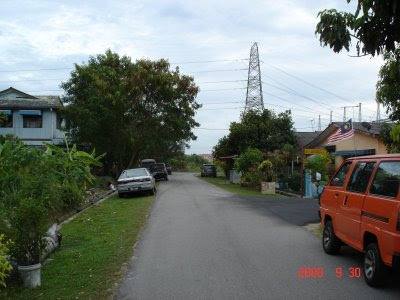
The house also has a swimming pool, several gazebos, an orchard, a two-hole golf lawn, an office, a storeroom, two rooms for maids as well as a wet kitchen and a dry kitchen.
This House is sitting on the north and facing south. In the rat's year, that is in year 2008, the yellow 5 flies to the South which is considered bad for house facing South.

In month 2, the black 2 flied to the South. When the yellow 5 and black 2 crossed, the owner of the house where the sitting is on the north, will be affected. Zakaria died of heart attack may have something to do with feng shui.
His house is facing a road which is bad when fellow 5 and black 2 arrived. His bedroom also faced a tenaga electric tower which is also "no good" for the owner of the house.
South refects the heart. The south sector also has "three killer" which is considered bad when your house is facing it, especially there is tenaga electric tower to ignite the negative energy.

This is the Tenaga Electric Tower facing his bed room.

Can you count how many cars you can park in front of the mansion?

This road is just infront of his mansion.

Friday, February 1, 2008
There was a feng shui war
In the heart of Kuala Lumpur there was a feng shui war between the ING building and the building infront which is known as Menara Boustead. Notice the canon infront of the the building--Menara Boustead. Feng shui lovers and tourists often come to this site to pay a visit and would love to hear stories from the security guards.


Thursday, January 31, 2008
When The Genting Founder dies, we were there to pay our last respect
Tan Sri Lim Goh Tong, founder and honorary life president of Genting Group, passed away on October 23, 2007 at 11.20am Tuesday at the Subang Jaya Medical Centre.
The tycoon, who turned 90 in April 2007, was renowned for his vision in transforming Genting Highlands from an unexplored hilltop to one of the world's most successful casino resorts.
The fifth child in a family of seven children, Lim migrated from China's Fujian province in 1937 at the age of 19 with only a small suitcase and US$175.
The idea of a hill resort was chanced upon by Lim amidst the crisp air of Cameron Highlands in 1964. Lim was then working on a hydro-electric power project at the popular hill resort, patronised mostly by British colonials seeking cool refuge from the tropical heat, when he foresaw a prosperous Malaysia of the future desiring a cool mountain holiday resort within the reach of all Malaysians.
To date, Genting Highlands Resort has five hotels and two apartment blocks at the hilltop and Awana Genting Highlands Golf and Country Resort.
The company, founded in 1965, has since expanded and diversified from its initial hotel and resort activities to plantations, properties, paper manufacturing, power generation, oil and gas, electronic commerce and information technology development under Genting Group.
According to Forbes Asia, the Genting Group founder was third richest in the country with a net worth of US$4.3bil (RM14.6bil).
Lim is survived by wife Puan Sri Lee Kim Hua, and their six children and 19 grandchildren.
On October 29, 2007(Monday), the burial at 1.18pm was a private affair for family members only.
The funeral on Monday ended five days of wake beginning last Wednesday after Lim died at the Subang Jaya Medical Centre.
Over the past five days, more than 20,000 people, including royalty, Asia's rich and famous, politicians, friends, business allies and members of the public had either attended the wake or sent wreaths and words of condolence.
The wreaths lined up the road to Gohtong Villa, stretching a distance of more than 1km.
We also attended the wake and sent words of condolence. Master Yeo and I together with a few feng shui followers also took this opportunity to study Uncle Lim's feng shui arrangement. We found that the Pagoda at Genting Highland has powerful feng
shui effect.

This is Master Yeo. According to him, the feng shui master of Uncle Lim is a very traditional master using San He formulae. If you visit Jiang Xi and studied the feng shuis that were designed by the Great Grand Master Yang Yun Song, they were all using San He method.
The interviews of Master Yeo about the feng shui of Genting Highland came out in the Special Weekly on issue 351 and 352 published on November, 26 2007 and December 3, 2007 consecutively.

In the issue 352, Master Yeo advised the visitors to take the lucky route on the left as shown in the picture to increase the probability of winning and to command better "qi" instead of going straight where the feng shui does not benefit visitors to the casino.

This is Master Goh, the author of this blog. You will notice there is a mountain at the back of Uncle Lim's bungalow which forms the support for the house. Master Yeo and Master Goh were in Jiang Xi, China, in 2001, to study the feng shuis that were designed by the Great Grand Master Yang Yun Song.
The tycoon, who turned 90 in April 2007, was renowned for his vision in transforming Genting Highlands from an unexplored hilltop to one of the world's most successful casino resorts.
The fifth child in a family of seven children, Lim migrated from China's Fujian province in 1937 at the age of 19 with only a small suitcase and US$175.
The idea of a hill resort was chanced upon by Lim amidst the crisp air of Cameron Highlands in 1964. Lim was then working on a hydro-electric power project at the popular hill resort, patronised mostly by British colonials seeking cool refuge from the tropical heat, when he foresaw a prosperous Malaysia of the future desiring a cool mountain holiday resort within the reach of all Malaysians.
To date, Genting Highlands Resort has five hotels and two apartment blocks at the hilltop and Awana Genting Highlands Golf and Country Resort.
The company, founded in 1965, has since expanded and diversified from its initial hotel and resort activities to plantations, properties, paper manufacturing, power generation, oil and gas, electronic commerce and information technology development under Genting Group.
According to Forbes Asia, the Genting Group founder was third richest in the country with a net worth of US$4.3bil (RM14.6bil).
Lim is survived by wife Puan Sri Lee Kim Hua, and their six children and 19 grandchildren.
On October 29, 2007(Monday), the burial at 1.18pm was a private affair for family members only.
The funeral on Monday ended five days of wake beginning last Wednesday after Lim died at the Subang Jaya Medical Centre.
Over the past five days, more than 20,000 people, including royalty, Asia's rich and famous, politicians, friends, business allies and members of the public had either attended the wake or sent wreaths and words of condolence.
The wreaths lined up the road to Gohtong Villa, stretching a distance of more than 1km.
We also attended the wake and sent words of condolence. Master Yeo and I together with a few feng shui followers also took this opportunity to study Uncle Lim's feng shui arrangement. We found that the Pagoda at Genting Highland has powerful feng
shui effect.

This is Master Yeo. According to him, the feng shui master of Uncle Lim is a very traditional master using San He formulae. If you visit Jiang Xi and studied the feng shuis that were designed by the Great Grand Master Yang Yun Song, they were all using San He method.
The interviews of Master Yeo about the feng shui of Genting Highland came out in the Special Weekly on issue 351 and 352 published on November, 26 2007 and December 3, 2007 consecutively.

In the issue 352, Master Yeo advised the visitors to take the lucky route on the left as shown in the picture to increase the probability of winning and to command better "qi" instead of going straight where the feng shui does not benefit visitors to the casino.

This is Master Goh, the author of this blog. You will notice there is a mountain at the back of Uncle Lim's bungalow which forms the support for the house. Master Yeo and Master Goh were in Jiang Xi, China, in 2001, to study the feng shuis that were designed by the Great Grand Master Yang Yun Song.
Monday, January 28, 2008
Feng Shui Tour To China in year 2000
Sometime in October 2000, I have managed to organised a Feng Shui Tour to China, with Professor Kang Liang and Grand Master Yap Ka Chin(deceased) as the advisors.
This is probably the first feng shui delegation from Malaysia with about 15 members. We have managed to invite feng shui masters from Penang, Johore, Malacca, Selangor and China to join the tour.
We have visited many feng shui tombs and locations to verify the feng shui theories that we have learned.
It is an eye opener for some of us where we can learn from so many masters , most importantly, we can study the feng shui of the respective location in person.
Of course, we have visited Imperial Palace where many emperors have lived and ruled. It has many feng shui designs and set-up. We can study the richness of Chinese culture.

Our visit to Imperial Palace in year 2000 with Professor Kang Liang and Grand Master Yap Ka Chin(now deceased).
Sunday, January 27, 2008
Our Feng Shui Trip to Gopeng
Sometime in December 2007, Master Yeo, and I together with two other feng shui enthusiasts, had taken a trip to Gopeng to look for dragon. Dragon point is a very good location for one to build houses or use as a burial plot so that the natural forces can be harnessed and one will be prosperous. 
Master Chan and Master Yeo. Master Chan is a famous feng shui master in Ipoh, Perak.
If you are not able to build your house, maybe you could use it as Sheng Ji, or life foundation, where you will place your clothing, hair, fingernails and your personal belongings in a small pot and bury it at the dragon point. You have to select a good date to match the sitting of the dragon point to ignite the feng shui. It is believed that you will make your million after a short spans of time.
I have known one feng shui enthusiast who was on the verse of bankruptcy. He then decided to build his own Sheng Ji. He consulted his master and managed to find a good location to do that. Later, his business became prosperous again and he made back his million. Now his business expended and he had two factories. He is in wood business.
This is Master Goh, the writer of the blog. This picture was taken at the dragon point where the durian tree was planted. The durian tree has enjoyed the energy of the dragon. Do you like to eat the durian which carry the qi of the dragon? They said it will give you good luck and prosperity.

Master Chan and Master Yeo. Master Chan is a famous feng shui master in Ipoh, Perak.
If you are not able to build your house, maybe you could use it as Sheng Ji, or life foundation, where you will place your clothing, hair, fingernails and your personal belongings in a small pot and bury it at the dragon point. You have to select a good date to match the sitting of the dragon point to ignite the feng shui. It is believed that you will make your million after a short spans of time.
I have known one feng shui enthusiast who was on the verse of bankruptcy. He then decided to build his own Sheng Ji. He consulted his master and managed to find a good location to do that. Later, his business became prosperous again and he made back his million. Now his business expended and he had two factories. He is in wood business.

This is Master Goh, the writer of the blog. This picture was taken at the dragon point where the durian tree was planted. The durian tree has enjoyed the energy of the dragon. Do you like to eat the durian which carry the qi of the dragon? They said it will give you good luck and prosperity.
This video shows Master Yeo, Master Goh and other feng shui enthusiasts climbing the mountain, searching for dragon in Gopeng.
善易者不卜 A Person who is conversant with Yi Jing should not consult the oracle
古人说,善易者不卜。
最近,有人告诉我他对易经的体验;他说,他在分析之后认为是进场好时机,于是决定第二天一早进场买股票,便“打道回府”,但想不到办公室门被锁,因为已经很夜。后来等了很久之后,保安人员才来开门。
他没有放在心上,第二天便按计划行事,但市场大跌,由于太过自信,因此,便按兵不动。
后来才想到困卦,就是在办公室被锁之事,易经卦象已显示,只是他没有留意。
假如他等市场稳定后才进场,则情况又会不同。不用卜卦,也可以用易经,这就是易经生活化。
The ancient people had said,"A Person who is conversant with Yi Jing should not consult the oracle."
Recently, someone told me about his Yijing experience. He said he has analysed the market and chart and found that the next day is the best time to enter. After he has made up his mind, he packed up and wanted to go home.
However, the office door was locked because it was quite late. He has to wait for quite sometime for the security guard to come back from his break before he could go home.
The next day, he followed his plan to enter the market, however, the market slid and he just watched it without cutting his losses because of overconfident about his analysis.
Suddenly, he thought of his experience the night before and it was Kun gua he encountered because he was locked in the office. Had he waited for the market to stablized or cutting losses, it would make world of difference. This is how we use YiJing in our daily life.
最近,有人告诉我他对易经的体验;他说,他在分析之后认为是进场好时机,于是决定第二天一早进场买股票,便“打道回府”,但想不到办公室门被锁,因为已经很夜。后来等了很久之后,保安人员才来开门。
他没有放在心上,第二天便按计划行事,但市场大跌,由于太过自信,因此,便按兵不动。
后来才想到困卦,就是在办公室被锁之事,易经卦象已显示,只是他没有留意。
假如他等市场稳定后才进场,则情况又会不同。不用卜卦,也可以用易经,这就是易经生活化。
The ancient people had said,"A Person who is conversant with Yi Jing should not consult the oracle."
Recently, someone told me about his Yijing experience. He said he has analysed the market and chart and found that the next day is the best time to enter. After he has made up his mind, he packed up and wanted to go home.
However, the office door was locked because it was quite late. He has to wait for quite sometime for the security guard to come back from his break before he could go home.
The next day, he followed his plan to enter the market, however, the market slid and he just watched it without cutting his losses because of overconfident about his analysis.
Suddenly, he thought of his experience the night before and it was Kun gua he encountered because he was locked in the office. Had he waited for the market to stablized or cutting losses, it would make world of difference. This is how we use YiJing in our daily life.
Friday, January 25, 2008
Our Feng Shui Team
Our feng shui team is headed by Master Yeo, who is being consulted by the business communities in China, Taiwan, Thailand, Indonesia, Malaysia and Singapore. One of the companies he was asked to feng shui was losing lots of money and was in red for many years, however, after consultation, he is able to make the company turn around and started to make money. On the second year, he was asked to look for a bigger office so that they could move to in order to accomdate the growing business. 
On the left is Master Yeo, who is explaining landscape feng shui to one of his students.

Normally the location of a graveyard would have to face a mountain or the feng shui master called it Chu San.

Master Yeo is a serious teacher, he takes time to explain the surrounding feng shui to his students. Landscape feng shui is a complicated but important subject. A feng shui teacher should be able to master the landscape feng shui in order to harness the qi and natural power of feng shui.
He can tell you many cases of how he had turned around the companies that he feng shuied. What he is using is Xuan Kong Liufa, a very traditional feng shui techniques where many feng shui masters are still not aware. Master Yeo was born in Tawau, Sabah. He started to learn Yijing and feng shui since 1987. His feng shui teachers are from China, Taiwan, Singapore and Malaysia.

You cannot learn landscape feng shui in the classroom, you need a teacher like Master Yeo who is willing to impart his knowledge of feng shui before you are able to learn,

Master Yeo said Flying Star is not feng shui, it is used for making prediction.
Master Goh started to learn yijing and feng shui since 1974. He begins with consulting many feng shui masters to align his house feng shui and later becomes a feng shui master because of his overwhelming interest to learn the skills. He has enjoyed the strength of feng shui after moving into a high class condominium where his income increases ten fold. He is also a stock broker, a writer and a speaker.
Master Goh is the one wearing red. He, Master Yeo and Master Wong were leading the students to Loke Yew's graveyard to observe the latter's feng shui. Loke Yew was a multi-millionaire in the very early years.
Master Wong is the third to the left. Master Wong graduated from UKM, Bangi, Malaysia. He is an expert in Chinese culture and Yijing. He is a lecturer cum academic advisor of SCS Yijing HeLuo LiShu Research Centre. He is a Secretary cum cultural officer in Selangor and Kuala Lumpur San Cheng Tao Religious Association. He is also a research head cum committee member of Malaysia Zhu-Xi Philosophy Studies Association.

On the left is Master Yeo, who is explaining landscape feng shui to one of his students.

Normally the location of a graveyard would have to face a mountain or the feng shui master called it Chu San.

Master Yeo is a serious teacher, he takes time to explain the surrounding feng shui to his students. Landscape feng shui is a complicated but important subject. A feng shui teacher should be able to master the landscape feng shui in order to harness the qi and natural power of feng shui.
He can tell you many cases of how he had turned around the companies that he feng shuied. What he is using is Xuan Kong Liufa, a very traditional feng shui techniques where many feng shui masters are still not aware. Master Yeo was born in Tawau, Sabah. He started to learn Yijing and feng shui since 1987. His feng shui teachers are from China, Taiwan, Singapore and Malaysia.

You cannot learn landscape feng shui in the classroom, you need a teacher like Master Yeo who is willing to impart his knowledge of feng shui before you are able to learn,

Master Yeo said Flying Star is not feng shui, it is used for making prediction.
Master Goh started to learn yijing and feng shui since 1974. He begins with consulting many feng shui masters to align his house feng shui and later becomes a feng shui master because of his overwhelming interest to learn the skills. He has enjoyed the strength of feng shui after moving into a high class condominium where his income increases ten fold. He is also a stock broker, a writer and a speaker.

Master Goh is the one wearing red. He, Master Yeo and Master Wong were leading the students to Loke Yew's graveyard to observe the latter's feng shui. Loke Yew was a multi-millionaire in the very early years.
Master Wong is the third to the left. Master Wong graduated from UKM, Bangi, Malaysia. He is an expert in Chinese culture and Yijing. He is a lecturer cum academic advisor of SCS Yijing HeLuo LiShu Research Centre. He is a Secretary cum cultural officer in Selangor and Kuala Lumpur San Cheng Tao Religious Association. He is also a research head cum committee member of Malaysia Zhu-Xi Philosophy Studies Association.
Subscribe to:
Posts (Atom)